Medieval ink There were two
Medieval ink
There were two

Medieval ink
There were two very different types of ink used by medieval writers. The first was carbon ink, made of charcoal or lamp-black mixed with a gum. The second was metal gall ink (usually iron gall), which was made by mixing tannic acid with ferrous sulphate and adding gum as a thickener.
Carbon ink was used in the ancient and eastern worlds. It occurs in all medieval manuscripts until the Twelfth Century. The use of gall ink then became popular and was as used in almost all later medieval manuscripts.
Iron gall ink is made from "oak apples", ball-like growths found mainly on the leaves and twigs of oak trees. They are formed by the gall wasp. It lays its egg in a bud of the tree causing an apple-like ball, about the size of a marble, to form around the developing young. These balls were crushed and soaked in warm rainwater for several days to make ink. Sometimes white wine or vinegar was used instead of rainwater.
The second ingredient was ferrous sulphate, known also as copperas, green vitriol, or salmortis. By the late Sixteenth Century, copperas was made by pouring sulphuric acid over scrap iron, then filtering the liquid and mixing the filtrate with alcohol.
When the copperas was added to the oak-gall water the resulting solution slowly turns from pale brown into black ink. Some ground-up gum arabic was added to make the ink thicker.
Iron-gall ink undergoes a chemical change when exposed to air and light and darkens considerably on the pages of a manuscript.
Coloured Ink
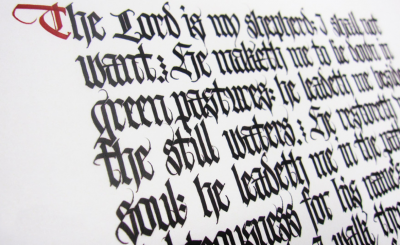
Red ink was used extensively in medieval manuscripts. It was the colour of headings, titles and initials. It was also used for important days in the calendar, hence the expression "red-letter day".
The process for making red ink was to grinding mercuric sulphide, mix it with egg white and gum arabic. It was also made from brazilwood chips infused in vinegar and mixed with gum arabic.
It was rare to find blue or green inks. These rare colours were much more complicated to produce and used less as a result.
One of the best examples of ancient British calligraphy is the Lindisfarne Gospels out., featured on the site in May 2003.
The colourful single volume manuscript was produced more than 1300 years ago at the monastery of Lindisfarne on the Northumbrian coast. It consists of 500 pages of beautiful calligraphy and decorative symbols.
Click here out. to read the article.
Comments
Leave a comment Trackback