Explore Britain with! King Henry VI

484575b84bcc2HenryVIII_1509.jpg

Explore Britain with! King Henry VIII

This month we're heading to Tudor England and what better guide than one of England's most famous and revolutionary monarchs, Henry VIII? Our historian, Susannah Stapleton, tags along.

Early Years

Henry VIII was born at Greenwich Palace on 28th June, 1491. As the second son of Henry VII and Elizabeth of York, he did not expect to become king and his boyhood was spent quietly at Hampton Court out. where, if you visit at the right time, you can watch a game being played. (Hampton Court Palace also has a new permanent exhibition about the young Henry VIII, with a further programme of exhibitions and events planned for the run up to the 500 year anniversary of his coronation in 2009.)

When not playing tennis, Henry was often to be found atop a horse, indulging in another great passion, jousting. His armour is on display in the Tournament Gallery at the Queen Elizabeth's Hunting Lodge out., the site hosts monthly events which focus on various aspects of Tudor life.

With such displays of sporting prowess, it would be easy to dismiss Henry as "all brawn and no brains'. However, he also had a keen intellect and curiosity about a wide range of subjects. He loved music, composing many songs and poems, and was particularly interested in astronomy, maps and scientific instruments. If he were alive today, no doubt Henry would be heading straight to the Museum of the History of Science out. at Oxford to explore its huge collection of gadgets and tools, including many from his own time.

HenryHolbein.jpg

Henry VIII as a young man in 1509

Divorced, Beheaded, Died!

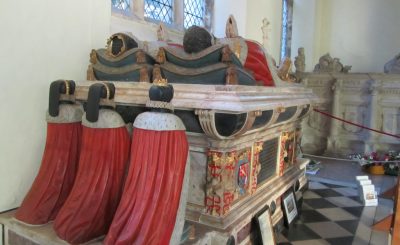
One fact that most people know about Henry VIII is that he got through six wives in his attempt to secure a male heir to the throne. In 1533, after 24 years of marriage, he divorced Katherine of Aragon, whose two sons had died in infancy (but whose daughter would grow up to become Queen Mary I). Katherine died in 1536 and was buried in the magnificent Peterborough Cathedral out.; her tomb can be found in the North Aisle.

Anne Boleyn came next and lasted three years (during which time she produced the future Queen Elizabeth) before being beheaded for infidelity in 1536. One site connected with Henry VIII and Anne Boleyn is

Henry VIII in 1539 by his court painter, Hans Holbein the Younger

Henry may have stopped marrying at this point, had it not been for the death in 1536 of his 18-year-old illegitimate son, Henry Fitzroy, whom he had intended to make his heir. Needing another back-up heir for his son Edward, Henry married Anne of Cleves in 1540. It was not a successful union and they divorced six months later. Two properties included in her divorce settlement are particularly worth a visit: Sudeley Castle out. in 1548.

Rome and Ruins

Henry's various wranglings with marriage brought him into conflict with the Catholic Church. It started with the pope's refusal to grant an annulment of his marriage to Katherine of Aragon and ended with the formal withdrawal from Rome and the establishment of the independent Church of England in 1534. Along the way, Henry disbanded over eight hundred monasteries in England, Wales and Ireland, confiscating their property and dismantling many buildings. You don't have to go far from any point in England or Wales to find one of the resulting ruins, but some of the most spectacular include those of

Subscribe to comments