
History UK logo collage
History UK navigation bar
History UK Homepage
History Timeline
News about history in the UK
About Us
History UK Site Map
History Web Links
History UK navigation bar

Bookmark History.uk.com

Tell your friends about History.uk.com
Free History Newsletter
ITN Archive
Useful Resources for Historian
Historic Recipes
Family History Superstore
The 1940s
UK Web Archive Consortium
Information Britain


Quicksearch History.uk.com


For best results, click here for Advanced Search

 
yellow line

Introduction to calligraphy

Historians of all kinds appreciate the elegance, simplicity and beauty of calligraphy but few have taken the time to learn its secrets. This section offers a brief and basic introduction to one of history’s most evocative traditional skills.

The term calligraphy comes from two Greek words, kale graphe meaning beautiful writing. There are three main types of calligraphy: Oriental, Arabic and Western. Western calligraphy, arguably, has most relevance to UK historians.

Western calligraphy was developed over thousands of years, from Neolithic cave paintings and pictograms to magnificent medieval manuscripts and modern inscriptions.

It is hard to define calligraphy as either an art form or a craft. Experts say it encompasses the most enjoyable parts of both disciplines. Most importantly it is still evolving and has plenty of practical uses in today’s society. Certificates, awards, family trees and heraldry are all part of the modern day scribe’s task list.


Calligraphy examples in this section
reproduced with kind permission of
Kathy Luff www.kathyluff.co.uk


intro.jpg

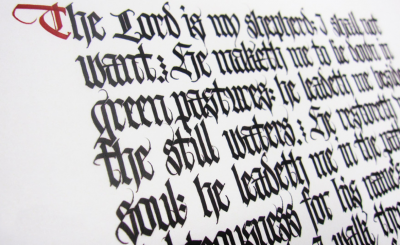
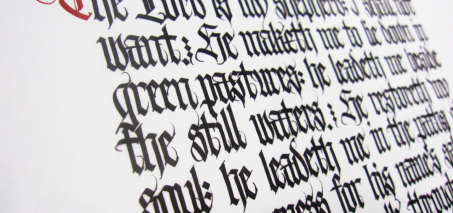
In its basic form, calligraphy is a form of artistic writing where letters are made in few or many direct strokes. The discipline can be expanded to include illuminated lettering, where individual letters are turned into illustrations, sometimes multicoloured or even gilded.

Go to your local library and look for books with examples of calligraphy. Visit your local museum and see if they have any illuminated manuscripts or ancient documents. By looking at different types of calligraphy you will gain a deeper understanding of the discipline to use in your own work.

In this section

To find out more about this beautiful skill follow the links below. The pages offer advice for the beginner as well as a glimpse at the medieval ink making process.

Getting started
Making a goose quill pen
Medieval ink

yellow line
Fri 06/12/02: Introduction to calligraph...
Fri 06/12/02: Getting started: A ...
Fri 06/12/02: Making a quill pen ...
Fri 06/12/02: Medieval ink There wer...

Introduction


Home / About / Contact us / Get a Free Premium Listing / Teachers / Disclaimer


British History on eBay
Best of British Magazine
Past Perfect Music
Ancestors Magazine from the Na
UKTV History
British Museum
Family & Local History
Not Tonight Josephine
Buckinghamshire Railway Centre
Gurkha Welfare Trust
Flags for all occasions
Download Browsealoud
National Archives Domesday
Web design and hosting
Orchardacre Farm